Showing posts with label learning. Show all posts

Saturday, August 1, 2009

The super-futuristic library near my house

Near my house is a really beautiful, fully functional, modern library. The sleek gray building looks like it was designed by some hot-shot international architecture firm. When you walk through the gigantic glass gate surrounding the entrance, a moving LED screen alerts you of news about the library and events around town. Then you enter the lobby, which, though fully staffed, rarely has any lines because you can check out books yourself on special machines. Most people are at computers here, surfing the internet or viewing the library's book collection.

The library would be very good, except for a certain group of people who use the library. They start lining up outside the gate sometime around 7am (the library opens at 9am, I'm not sure exactly what time they start lining up because I don't get up that early on weekends). By the time the doors open, there is a huge line which snakes around the plaza in front of the library.
Students lining up outside the library. This photo was taken at eight in the morning on a Sunday.

I'm talking about students, of course. Which is all well and good-- I have no problem with kids who want to do well on their exams and study. The problem is that by the time I get there (which is usually in the early afternoon) there are literally no seats left. Again, this wouldn't be a problem if the kids were actually studying. But at any given time fully half of the occupied seats are unattended. What most of them do is leave their books at the place, and then go off with their friends to eat/play/chat somewhere outside the library.

Of course, in the West this would never work as people would be afraid of having something stolen and would always be at the desk, save for a bathroom break. But here no one seems to bat an eye.

There is one secret place, though, which I discovered when I first had the problem of searching for a seat. While floors one to four are chock-full of students (and/or their school accessories), the fifth floor is empty like Siberia, with only one or two seats taken (out of about a hundred).

I went to this floor (which to me seemed like the promised land of studying) quite often, until one day one of the staff informed me that I was not allowed to take books from outside to study there. Though I'm not sure exactly what she said, I imagine it was something like this:

"Excuse me sir, do you know you are not supposed to bring outside books into this area of the library?"

[confused expression]"What?"

She replied: "Please take your bag and put it in one of the lockers over there," at which point I took my bag, ambled over to the lockers, fiddled with one of them, then came back to where I was sitting and resumed studying.

I don't really feel bad about doing this because I find it's ridiculous that they have hundreds of perfectly good seats downstairs which could be put to better use. I wish they could have some kind of rule where if they see a place with someone's things unattended for over half an hour, they just confiscate it and let someone else sit there. Till that happens though, I'm going to be sneaking into the hidden library paradise of the fifth floor.

A video tour of the lobby (I was stopped by a guard before I could go further)

Saturday, May 30, 2009

The end, or a new beginning

You can tell it's the end of a semester at the Mandarin Training Center (MTC) just by looking at the practically empty library. Hallways are no longer filled with voices from all over the world. On Tuesday, the last day of class, two of my classmates were already out of the country (not that many but in a class of eight the difference is felt).

When I arrived in Taiwan, I was shocked to find out that I had to keep an 80% grade point average and a very good attendance record to keep my scholarship money coming in. I vowed to not skip class unless I was seriously ill or had an emergency. I have to say I felt really good on Wednesday when I picked up my report card (which I need to get my new student visa)- a perfect attendance record and grades all above 80%. Neither in high school nor in college did I feel the need to go to class every day or to get very good grades. I guess I'm growing up.

At the same time I did not get very good grades on my TOP test- kind of like a TOEFL for Chinese in Taiwan. I know even though I have studied a lot, I still need to practice more to get really good at Chinese.

That's why I've decided to stay here at least another year- to improve my Chinese and explore more of Taipei, a city brimming with noise and liveliness, and Taiwan, an exotic island with yet-to-be-discovered treasures. Next year will be different- I'll probably be more busy with work. But since I've already gotten over the 'adaptation' stage, I'll also be able to enjoy it more.

Now, in Taipei Taoyuan International Airport, I am about to go back to Japan for a couple of weeks.

Tuesday, December 30, 2008

Lost in pronunciation

For the past few days it's been getting slightly (but not uncomfortably) colder, and today the skies were really gray and it was drizzling a bit. It's fine with me, as long as it means there are no mosquitoes!

But besides that, I went to my Chinese class today. I had a small oral test, which I think I did really well on (only a few mistakes in pronouncing the tones!)

No, but really, I think my Chinese is improving. The problem with most foreigners, or should I say Westerners, for learning Chinese is the tones. Because we don't have any. So we either end up speaking a kind of pidgin Chinese which uses the sounds of Chinese with the tonalities of our language or we end up making up tones for the words we don't understand (very dangerous because you may be swearing at the person without even knowing it) or, most often, we just spit out a bunch of monotonous sounds that we think mean something but sound like gibberish to a Chinese speaker.

In that respect, I'm kind of envious of the Vietnamese kid in my class. I mean, he doesn't pronounce perfectly, but his tones are spot on (coming from a country where they have seven tones, they better be). When tones are pronounced correctly, the Chinese language seems to come to life, and you can add real feeling to your voice.

I've been working on relearning some basic words because, frankly, in France I didn't really learn to pronounce Chinese correctly. Mispronunciation (or lack of pronunciation) leads to the above mentioned gibberish, which leads to a situation where you are not understood, which leads to a plateau in learning.

I guess I went through the phase where I would make up tones when I didn't know which tone to use. And I'm still at that stage. Despite the risk of inadvertently insulting your neighbor (the most common one is if you say "I have a cold" incorrectly you could say "I have sex with cats"), I think it's actually better to say the wrong tone then use no tone at all. Because if you mention to someone that you smell see a movie, they can probably figure out that what you actually mean is that you want to see a movie (smell and want are similar sounds with different tones).

To get slightly (but not too) philosophical, Goethe said that when you learn a new language, you acquire a new personality (I know, I'm paraphrasing). And I think it's true. When I learned Japanese, I would say stuff that I wouldn't say in English or French. Now, hopefully I will give birth to a new, Chinese speaking Adrien.

OK. That sounded weird. Goodnight.


Thursday, September 18, 2008

Back to basics, and Ba Gua

Last Friday- I'm in my new Chinese class, with Teacher Zhu. In this class there are three Japanese, two Koreans, an Indonesian guy, an Indian guy, and a Canadian dude. At first I was a little bummed that I was in a lower level but now I realize it's probably the best thing that could happen to me. I know most of the characters (albeit in simplified form) and the grammar is not so hard. But in my first day in class we were reading passages from the textbook, with each student reading one line. So when it comes to my turn, I read off the characters as quickly and fluently as possible.
Teacher Zhu, dressed in light, pastel colors, (but not looking very easygoing) gives me a stern look and calls out my Chinese name: "Anjian." She looks at the other students.
"How is the character 'ke' pronounced?"
A chorus of voices pronounces it with a mild upward tone, as if asking a question: "ke?"
"That's right, second tone. You need to work on your tones, Anjian. Buy a red pen and mark the tones above all the characters, then practice them. Next student."

So this week I've been going over my basic characters, pronouncing them slowly and carefully. It's a mind-numbing task, considering I've been saying them wrong, or sometimes, just not pronouncing the tones. I have to relearn everything, but I think in the long term it will be worth it because I'll actually be understood when I speak. And I'm getting better.

Tuesday- A (Chinese) American I met, Jon, invited me to go to a Ba Gua class. I was really excited about this because I had heard about Ba Gua but never seen it. It's an internal martial art, which means that, like Tai Chi or Aikido, it's based on 'Qi' or internal energy instead of raw strength. Wondering whether it was going to be foreigner-friendly or all in Chinese, I asked if there were many foreigners at the class.
"It's taught by a foreigner," said Jon.
I had heard of these types of classes, taught by ex-pats who had years of experience. They were rarely advertised and mainly expanded through word-of-mouth.
"Cool, what's his name?"
"Fox."
I had never heard of Fox, but it would be interesting to see what the class would be like.

When I got to the location (which I will not divulge, except to say that it's a public area) there were a few students warming up and some young b-boy kids nearby, playing hip-hop and practicing freezes. I stretched a bit with Jon and made small talk. Then I saw a big black guy approach. He was wearing athletic wear and clear sunglasses, a la RZA, . At first I thought he was meeting the b-boys.
That was Fox.
Fox has a muscular physique, but carries it effortlessly, more like a dancer than a bodybuilder. Spotting me as the new student, he came directly towards me and greeted me.
"Yo, what's up man? Have you ever practiced Kung Fu before?"
"Uh...yeah, I practiced in France a modern style."
"Cool, I teach Ba Gua. It's a bit like Kung Fu, but kinda different. You'll see."

The class was good, more athletic than Tai Chi, but not as demanding as Kung Fu. Though the moves could be considered internal, Fox preferred a hands-on approach, making us practice in pairs.
Occasionally the b-boys would check out some of the moves we were doing, interested in the circular movements of the Ba Gua. Likewise, sometimes we couldn't help but check out the b-boys' crazy acrobatics. It was a moment where the cultural visions of each were reversed- a group of young Taiwanese practicing a relatively new dance form created in the West, and some waiguoren practicing an age-old martial art invented in the East.
Not sure if I'm going to stick with this particular martial art (there are tons here and I should check some out before making a decision) but it's a step in the right direction.

Monday, September 8, 2008

Back to school

So I had my first day at school. In the class, taught by a Ms. Li, there are six women and two men (including me). There are two Vietnamese (one man and one woman), a Balinese, a Thai, a Russian, a Japanese, and a Korean. In the class we give self-introductions which takes about an hour (the class is two hours long). I was surprised to hear that most of them had been studying Chinese for under a year. But I'm cool with this. Sure, they are using some words I don't know, but I understand the general gist.
Then the next hour comes. The teacher hands us a sheet, all in Chinese, of how the class is to be carried out. I can read some of it but am anxious that I miss something important. She talks about 'tingxie.' Of course I know what that means because we used to do it all the time in France (dictée or dictation). She goes on to explain how the class will go, but I only understand a few words and have no idea about the general meaning. I start to get a little nervous. Actually, one of the requirements for the scholarship I am on is that I have to get grades of at least 80 percent. So that's where my anxiety was coming from.
Then we play a game where we each get cards with words on them and we have to explain the word without saying it and others have to guess what it means.
I don't know if it was the words they had chosen, but I suddenly felt like that time when I was six years old and learning how to swim and I just went into the deep end of the pool and freaked out and almost drowned (I didn't almost drown, but I thought I did). It wasn't just the fact that I didn't know most of the words, it was also that everyone was just speaking so comfortably and I was there, like a sitting duck. Now I know what my Junior High School Japanese students felt like when I tried to make them talk.
Ms. Lin said if anyone felt the class was too difficult she had no problem with letting them go. And that was my cue. As soon as the class was over, I went over to her and told her it was too hard. She explained to me calmly and clearly what it was I had to do.
I didn't understand any of it. (Actually, they had explained it in the orientation meeting, but I was, let's say, chemically imbalanced at the time.) After struggling a little, I finally understood the words 'sixth floor'.
I went to the sixth floor and told them I wanted to change classes. They asked me if I had talked to my teacher about what level I needed to be in. "Maybe you should talk with her about your level.' They said. So I went back upstairs to the teacher's office, found Ms. Li, and asked her what level she thought I should be in.
"Maybe you need to be in a group which uses book two," she said. She went and got the book.
I really didn't want to go to a group that uses book two. This is what I get after two years of university-level Chinese? She asked me if I knew the characters. Yes, I said, it's just that at my school in France we were learning simplified ones. "OK," she says, and starts to walk me to another office.
When we get to the office, they say that since I am a new student I need to stay in the class for at least two days to try it out. And that's that.
I think what really annoys me is that the school I went to in France, Inalco (allegedly the best in the nation for teaching Chinese), never taught us how to really speak. After I left the teacher and looked at my textbook and textbook two, I noticed that I knew about 90% of the words and most of the grammar. But it was just the combination of the inability to speak and the difficulty in listening which prevented me from participating in the class. And it's probably because at Inalco the most we had to do in class, in terms of communication, was nod our heads when the teacher asked if we understood and present a short dialogue which we had memorized in front of the class (JET teachers, does this ring a bell?)
Ultimately taking a few steps back will be good for me because it will consolidate the information I know and I'll actually learn how to speak it in a regular conversation. In the end, that's why I came here.

Sunday, September 7, 2008

The last week of summer...


This past week was the last week before actually beginning classes. I saw Jean Robert, a class mate and documentary film director, for the last time before he went back to Paris (we had a Japanese style all-you-can-eat hot pot and grill). I went to the government office to sign up for my Alien Registration Card. Mr. Zhang took me to the grocery store (huge, but I couldn't find any canned tomatoes).
On Friday I went to ShiDa, the university I will be going to, for the orientation meeting and to find out my schedule. I managed to arrive at the red-brick building where the meeting took place on time, but I didn't have time to get a coffee before arriving. So you can imagine the headache I had during the whole meeting (OK, I admit, I'm addicted to caffeine.)
After the meeting, which IMO didn't have anything really interesting to say, I went downstairs to get a coffee before getting my schedule and books. I figured by the time I got back upstairs the long line for the schedules would have disappeared.
I ordered a 'bing' (iced) coffee at the small cafe downstairs and sipped it slowly, visualising the receptors in my brain which were firing up after getting a healthy dose of caffeine. Magic.
But when I returned back to the fifth floor, surprise, there was still a super long line which I had to wait in. I saw a guy who looked completely lost, and saw others try to talk to him in English and show him where to go. Still clueless. He fixed his gaze on me and then asked me in French "do you know where I need to go?"
I quickly translated everything the other person had said in English. "Orientation is over there," I said, pointing towards the door.
"Yeah, I bet the orientation is in English too!" He replied.
"And Chinese!" I joked.
That was weird. How did he know I was French?
Anyway, after I finally got my schedule, I went upstairs to get my books. I looked at the paper. Dammit! I start classes at 8:10AM! I'm not sure what my level is but my book says level 3, so it can't be that bad. I mean, I had been worrying that either a) they noticed I had taken two years of university-level Chinese, so would put me in a super difficult class, or b) they noticed how I bombed the evaluation test, and would put me in a beginner's class. But it seems they put me in a class which is not too difficult but still challenging (to be confirmed in the near future).
This weekend I tried to practice some more traditional characters, looked at my textbook a little, and got fed chou (stinky) tofu by Mr. Zhang. I had asked him about the restaurant downstairs, and he said he didn't know if it was any good but that he could make me some. So on Saturday I tried it. The tofu, which looks and smells like a fresh cow patty (OK, actually it only smells like one), doesn't taste so bad, a bit like a spongy fermented cheese.
Today, to return the favor, I made spaghetti bolognese for Mr. Zhang, his son, and his mother (who came over for lunch). We talked in Chinese most of the time, which is good practice for me. I have no idea what the old lady is saying though, she just says stuff to me and laughs. I can't wait to speak Chinese well enough to understand because she seems to be having a hoot.

Thursday, September 4, 2008

The travails of learning (traditional) Chinese


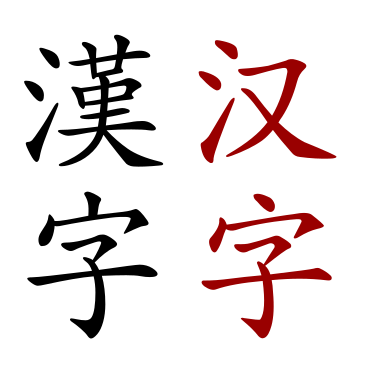
I start my classes next Monday, and to prepare I've been spending the past few days reviewing my traditional characters. This was one of the daunting things about going to Taiwan. Like Hong Kong and Macau, Taiwan decided not to use the simplified characters that mainland China adopted in the 20th century (by my count about one in every four characters have been simplified).
I thought it wouldn't be a big deal because I had already learned Japanese characters, which (I mistakenly thought) were traditional.
But it isn't as simple as that. The Japanese imported kanji throughout different eras, and thus have a mish-mash of traditional and simplified characters. Plus, after studying Chinese for two years, I know about 400 more Chinese characters than Japanese. So even if the Japanese ones were all traditional, I'd still have about 100 more traditional ones to learn. (for a list of examples, check here)
Not that learning traditional characters is without value. Once I know them, it will be a lot easier to study ancient Chinese texts...

Saturday, August 2, 2008

Background

A number of people have sent emails asking me what I am going to do in Taiwan. The short answer is: to study Mandarin Chinese. But to really answer that question, I have to give some background.
Two years ago, when I came back from Japan, I enrolled into Inalco, the national university for Oriental languages and culture, to study Chinese. Why Chinese, and not Japanese, you say? And why Chinese in France?
Well, I already spoke conversational Japanese, so I figured why not learn another language. Plus, I reasoned that Japanese characters are based on Chinese ones, so I already had a head start in the language.
I know now that that idea is not entirely correct. While it is true that Japanese characters are based on Chinese ones, many have changed their meaning in the same way that modern English has adopted new meanings for French words that became part of the English language hundreds of years ago. One that comes to mind is sensible, in English meaning logical or reasonable. In French it means sensitive. In Japanese, the characters showing a hand and a paper mean letter (as in a letter that you send someone). In Chinese the same two characters mean toilet paper. So that's the answer to the first question.
My friend Quint, with whom I taught English in Japan, asked me why I was learning Chinese in France. It's a good question, and it should be noted that the person asking has a Master's degree in teaching English as a foreign language. He knows that the best way to learn a language is to be in the country where that language is spoken. Most people would agree. But there is a corollary to that statement which many people are unaware of. In addition to living in a foreign country, the person wishing to speak the foreign language also needs instruction. Otherwise he ends up learning a type of pidgin language which, while allowing him to get what he needs, prevents him from being able to go beyond a basic survival level.
In my time in Japan, the foreigners who spoke the best Japanese were people who had studied it in universities in their home countries before going to Japan. Many of them were not from English-speaking countries and some could not speak English, giving them further incentive to learn Japanese. And some of them were-- you guessed it-- foreign exchange students who were there thanks to government scholarships.
So there you have it. That's why I'm going to Taiwan.